Visualization for Machine Learning

Autumn 2025

Agenda


  1. Clustering
  2. Dimensionality Reduction

Clustering

Etienne Bernard: “… the goal of clustering is to separate a set of examples into groups called clusters”
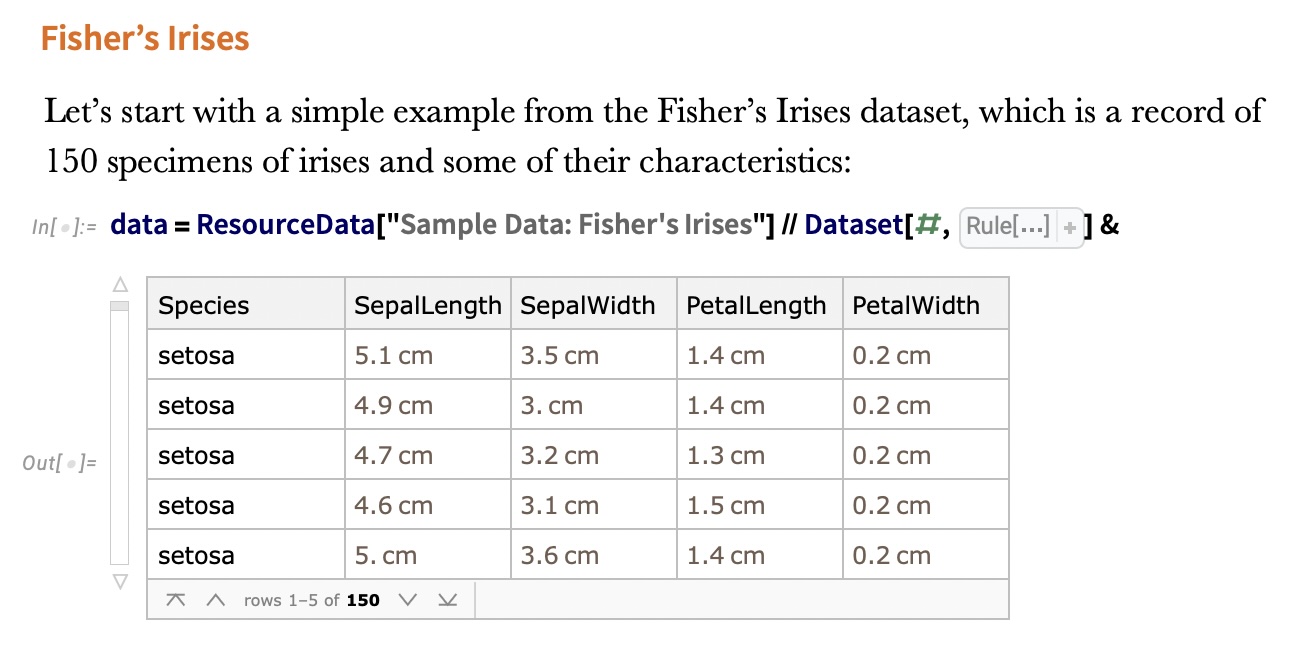
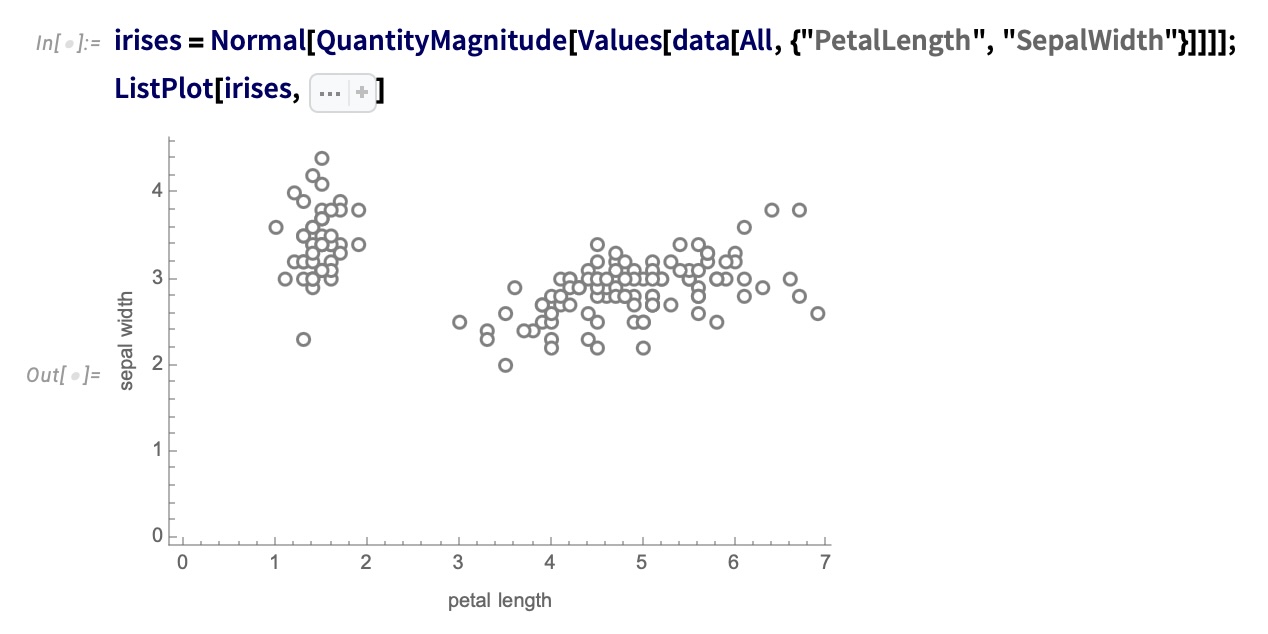
IRIS
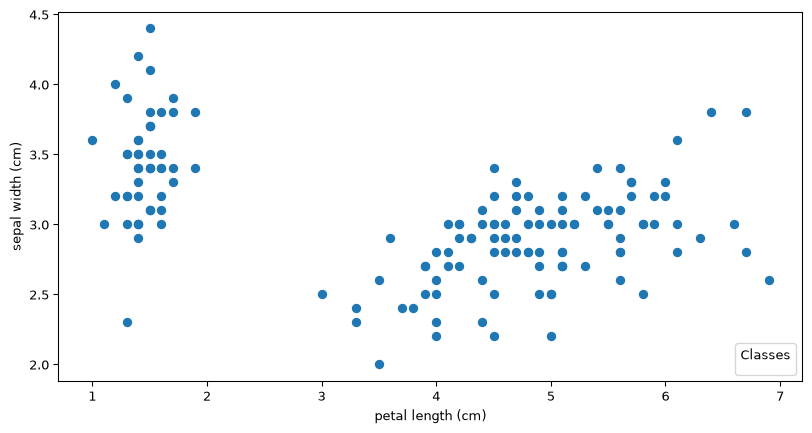
# Code source: Gaël Varoquaux
# Modified for documentation by Jaques Grobler
# License: BSD 3 clause
#
import matplotlib.pyplot as plt

from sklearn import datasets
iris = datasets.load_iris()

_, ax = plt.subplots()
scatter = ax.scatter(iris.data[:, 2], iris.data[:, 1])
ax.set(xlabel=iris.feature_names[2], ylabel=iris.feature_names[1])
_ = ax.legend(
    scatter.legend_elements()[0], iris.target_names, loc="lower right", title="Classes"
)

IRIS

IRIS – another look (Bernard)

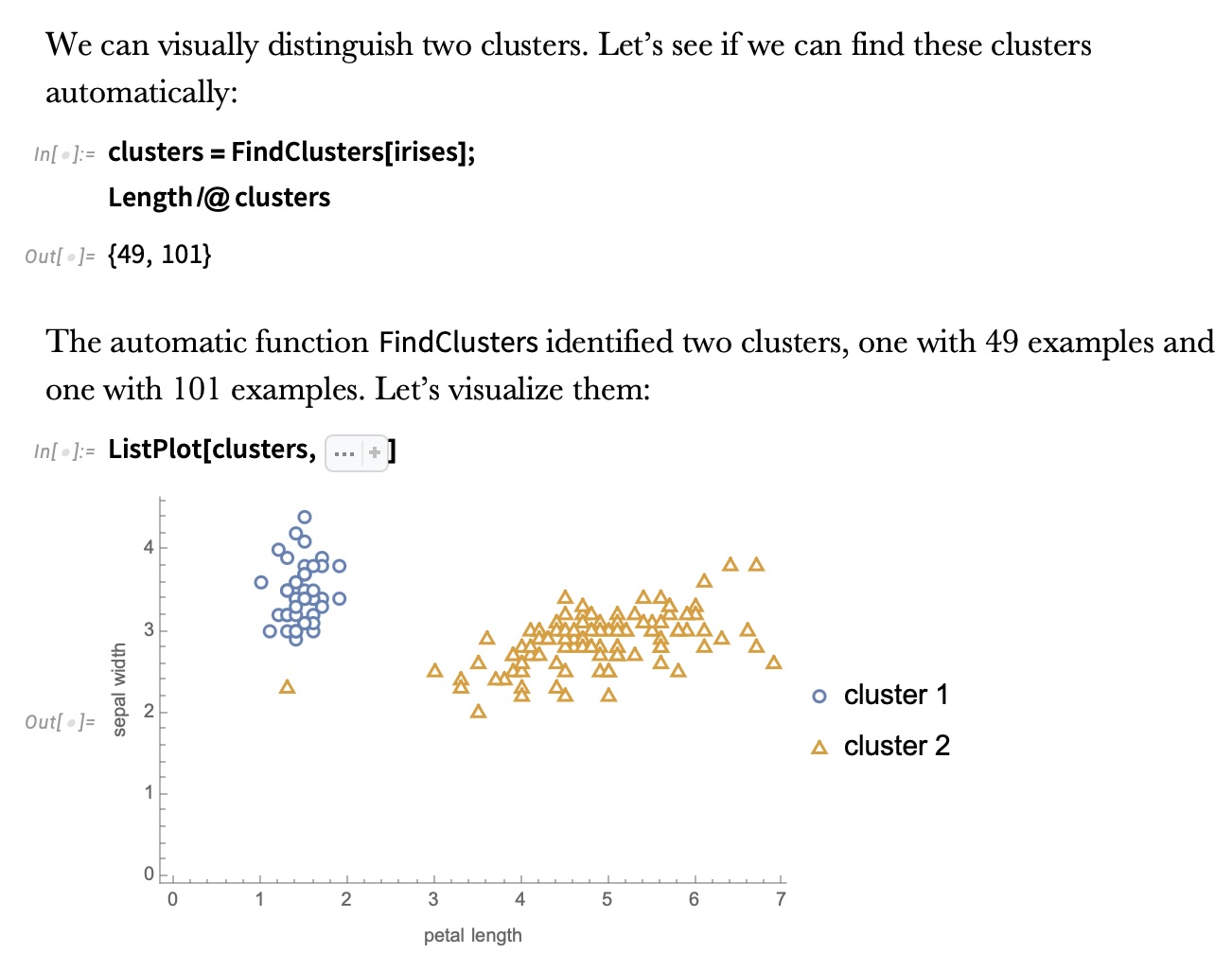
IRIS – clustering
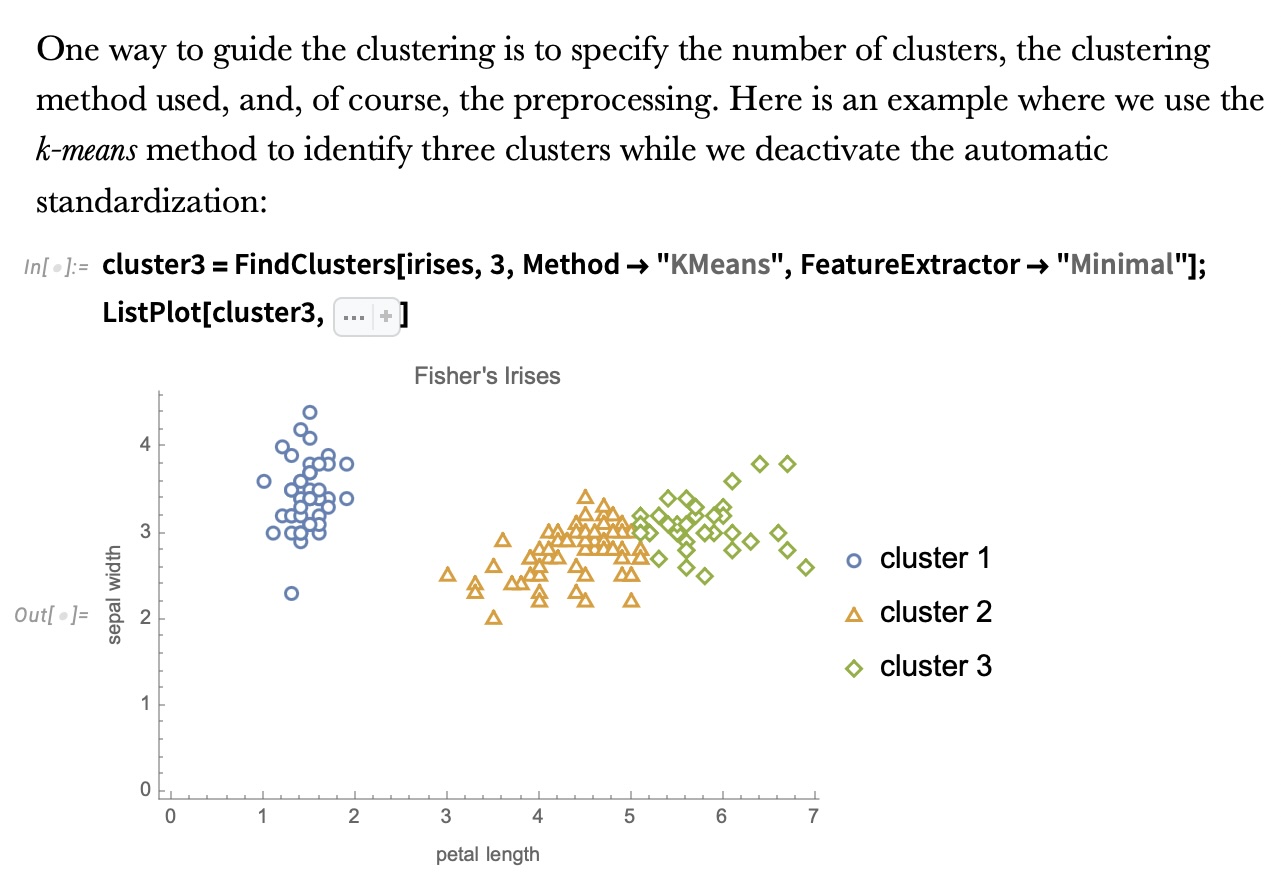
IRIS – k-means
Wolfram Mathematica FindClusters
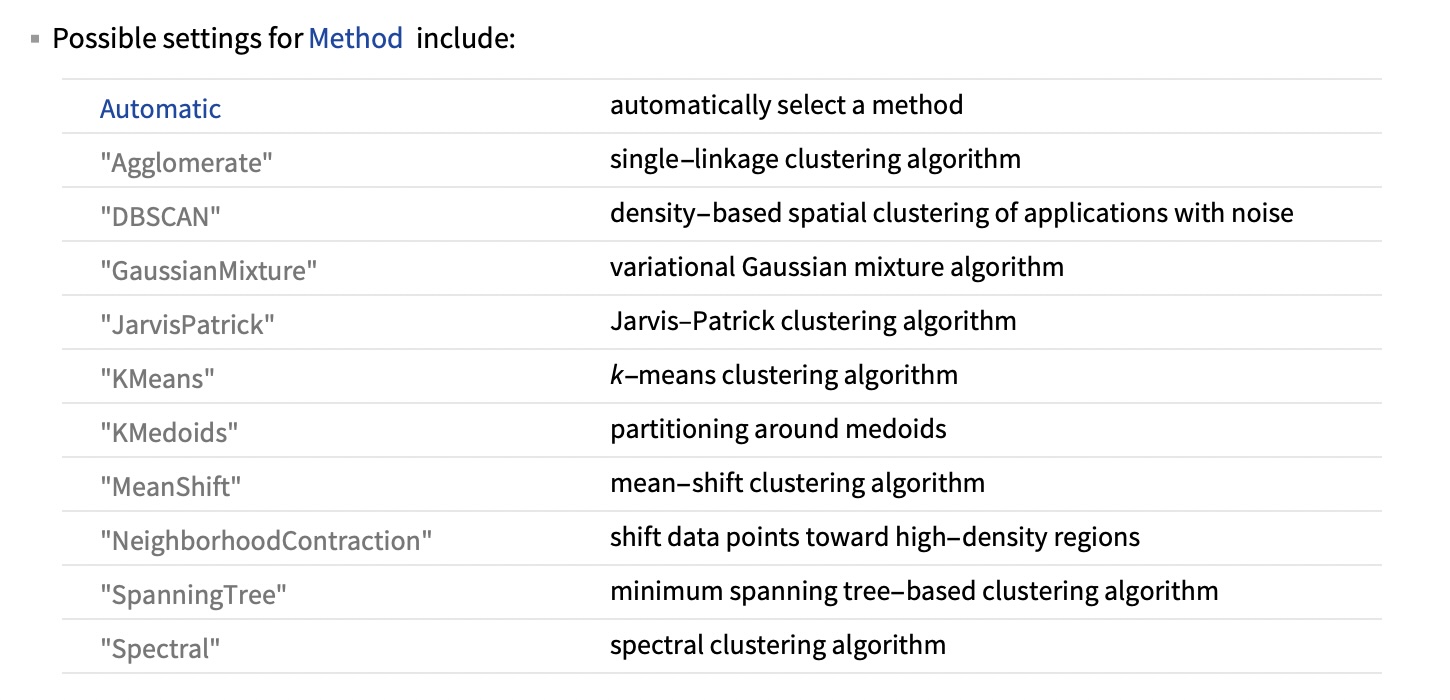
Wolfram Mathematica FindClusters
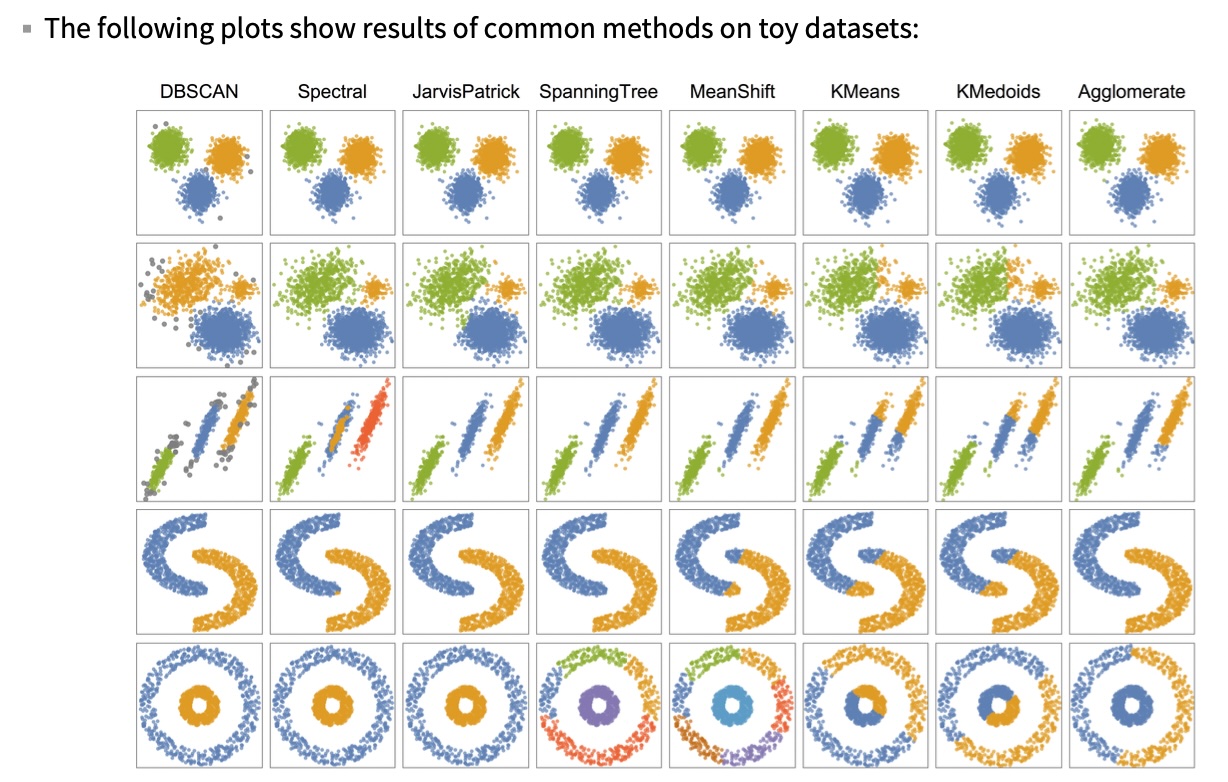
Dimensionality Reduction

  • Input data may have thousands or millions of dimensions!

  • Dimensionality Reduction represents data with fewer dimensions

    • easier learning – fewer parameters
    • visualization – show high-dimensional data in 2D or 3D
    • discover “intrinsic dimensionality” of the data

Dimensionality Reduction (Yi Zhang)

  • Assumption: data lies on a lower dimensional space
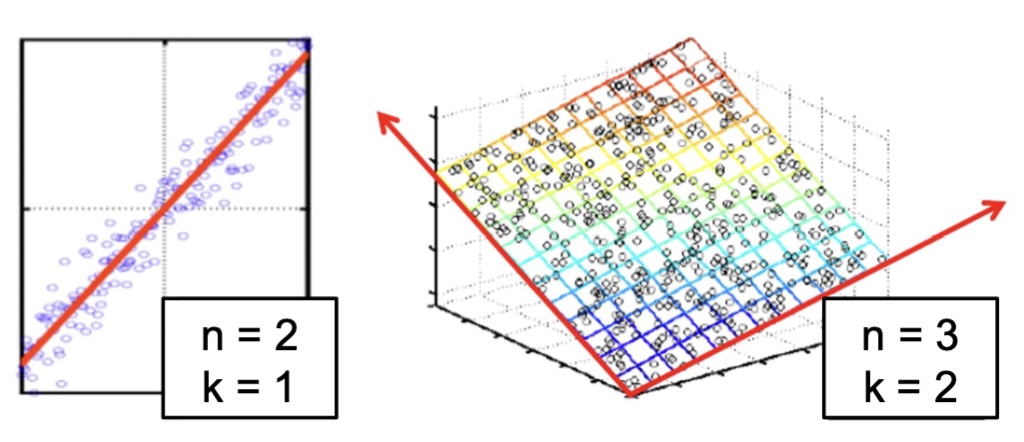
Dimensionality Reduction (Bishop)

  • Supposed a dataset of “3s” perturbed in various ways

  • What operations did we perform? What’s the intrinsic dimensionality?

  • Here the underlying manifold is non-linear

Digits
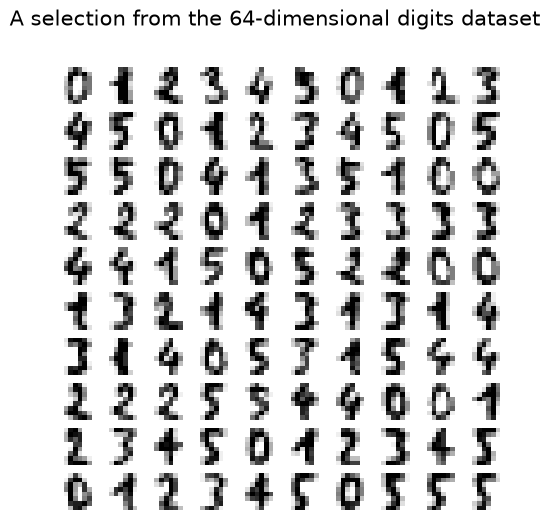
from sklearn.datasets import load_digits

digits = load_digits(n_class=6)
X, y = digits.data, digits.target

Digits - 0

array([[ 0.,  0.,  5., 13.,  9.,  1.,  0.,  0.],
       [ 0.,  0., 13., 15., 10., 15.,  5.,  0.],
       [ 0.,  3., 15.,  2.,  0., 11.,  8.,  0.],
       [ 0.,  4., 12.,  0.,  0.,  8.,  8.,  0.],
       [ 0.,  5.,  8.,  0.,  0.,  9.,  8.,  0.],
       [ 0.,  4., 11.,  0.,  1., 12.,  7.,  0.],
       [ 0.,  2., 14.,  5., 10., 12.,  0.,  0.],
       [ 0.,  0.,  6., 13., 10.,  0.,  0.,  0.]])

Digits - 1

array([[ 0.,  0.,  0., 12., 13.,  5.,  0.,  0.],
       [ 0.,  0.,  0., 11., 16.,  9.,  0.,  0.],
       [ 0.,  0.,  3., 15., 16.,  6.,  0.,  0.],
       [ 0.,  7., 15., 16., 16.,  2.,  0.,  0.],
       [ 0.,  0.,  1., 16., 16.,  3.,  0.,  0.],
       [ 0.,  0.,  1., 16., 16.,  6.,  0.,  0.],
       [ 0.,  0.,  1., 16., 16.,  6.,  0.,  0.],
       [ 0.,  0.,  0., 11., 16., 10.,  0.,  0.]])

Digits

Digits

Principal Component Analysis

  • PCA is directly related to the eigenvectors and eigenvalues of covariance matrices.
  • Lets so make a quick review of eigenvectors, eigenvalues, and covariance matrices.

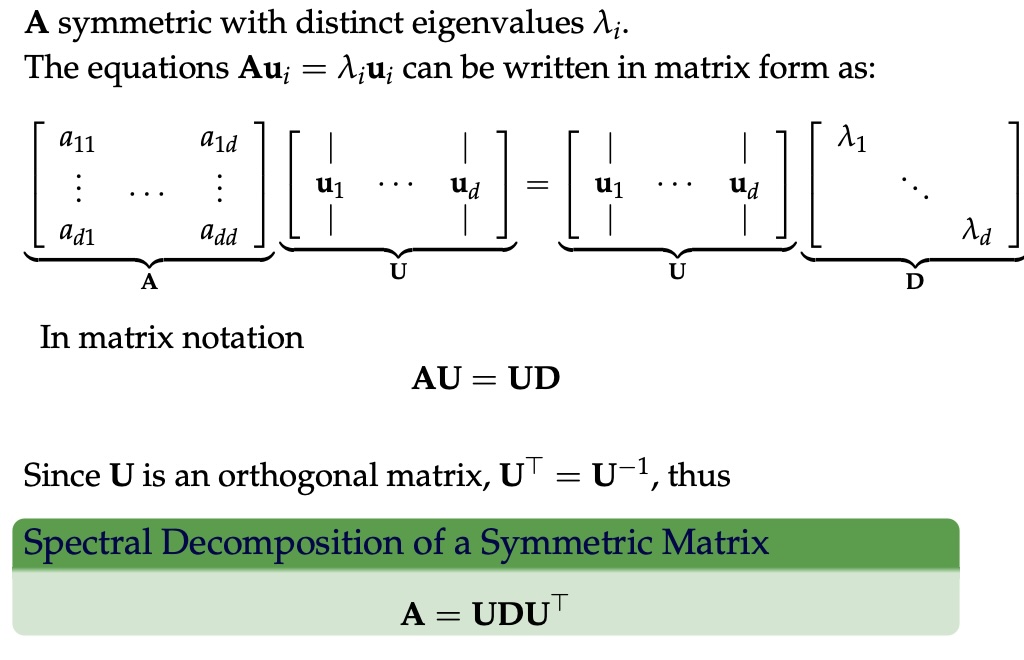
Eigenvectors and Eigenvalues

Given a \(d \times d\) matrix \(A\), a pair \((\lambda, u)\) that satisfies

\(A u = \lambda u\)

is called eigenvalue \(\lambda\) and corresponding eigenvector \(u\) of \(A\).

Symmetric Matrices

  • \(\lambda \in \mathbb{R}\) and \(u \in \mathbb{R}^d\) (no complex numbers involved)
  • The eigenvectors are orthogonal

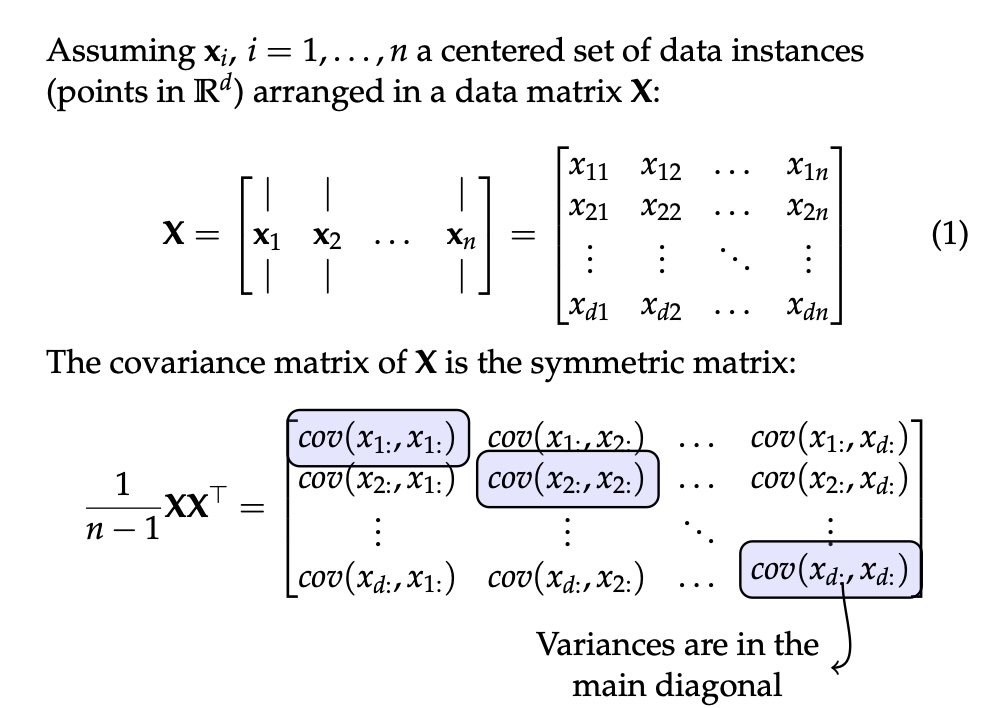
Covariance Matrix
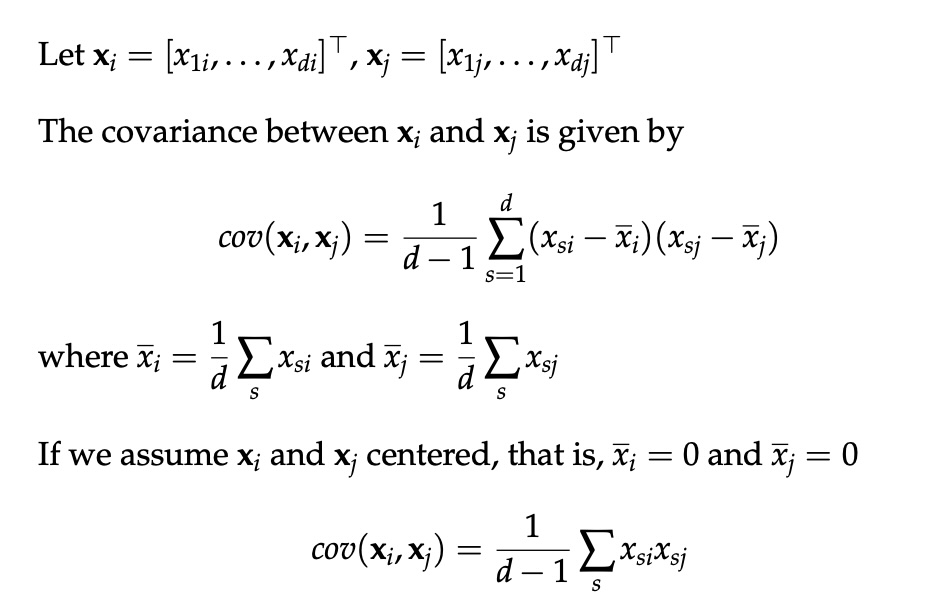
Covariance Matrix
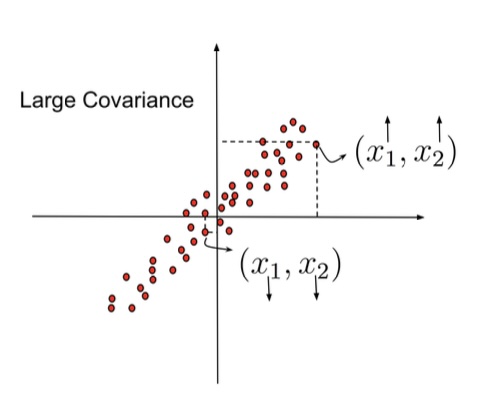
Covariance Matrix
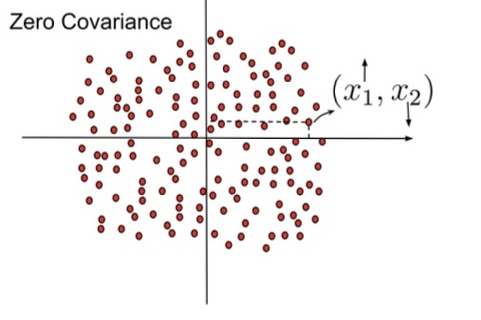
Principal Component Analysis: intuition
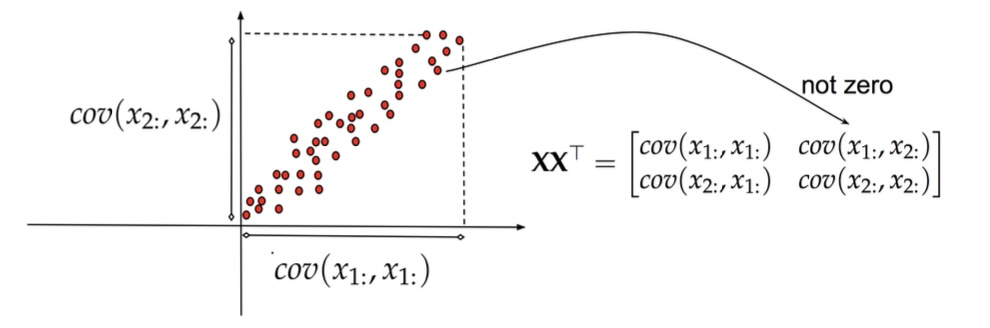
Principal Component Analysis: intuition
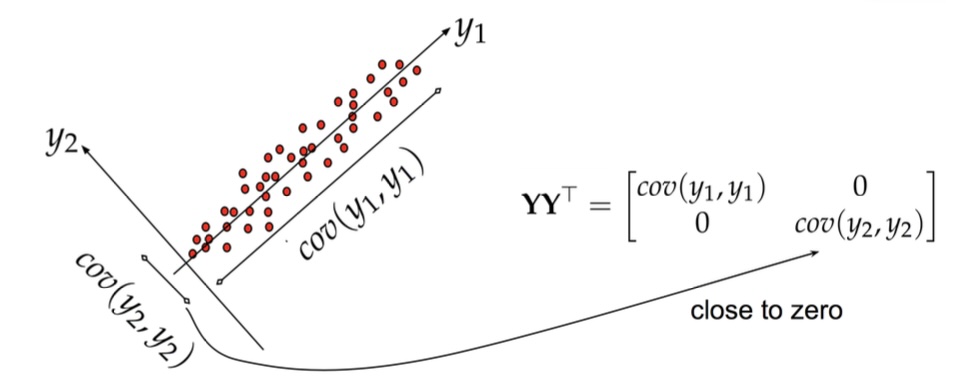
Principal Component Analysis
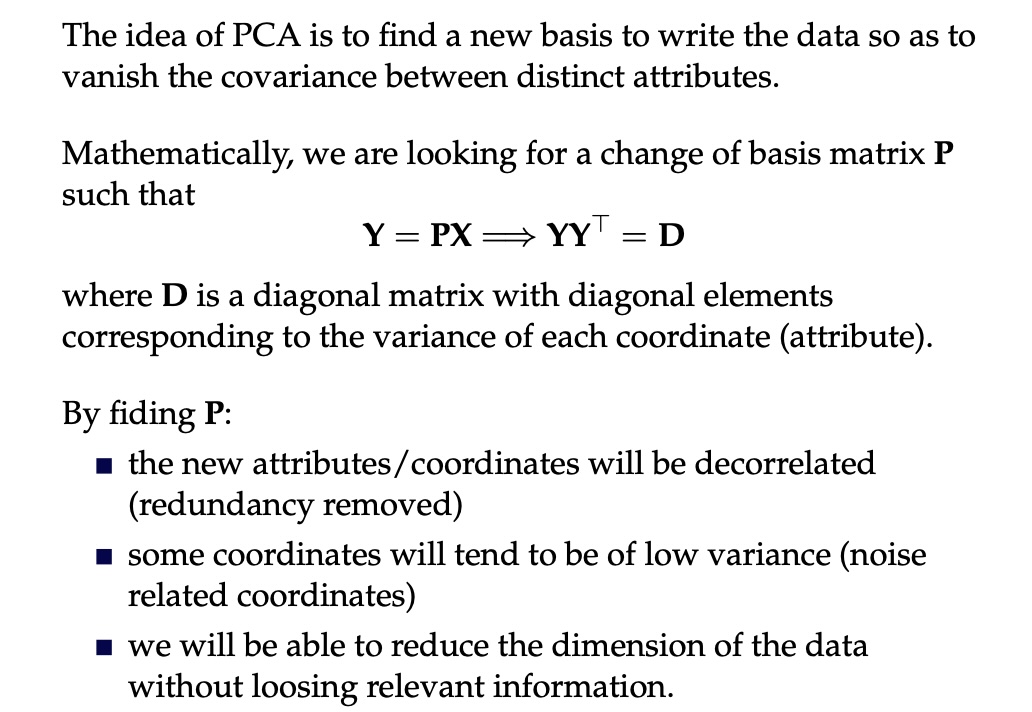
Principal Component Analysis
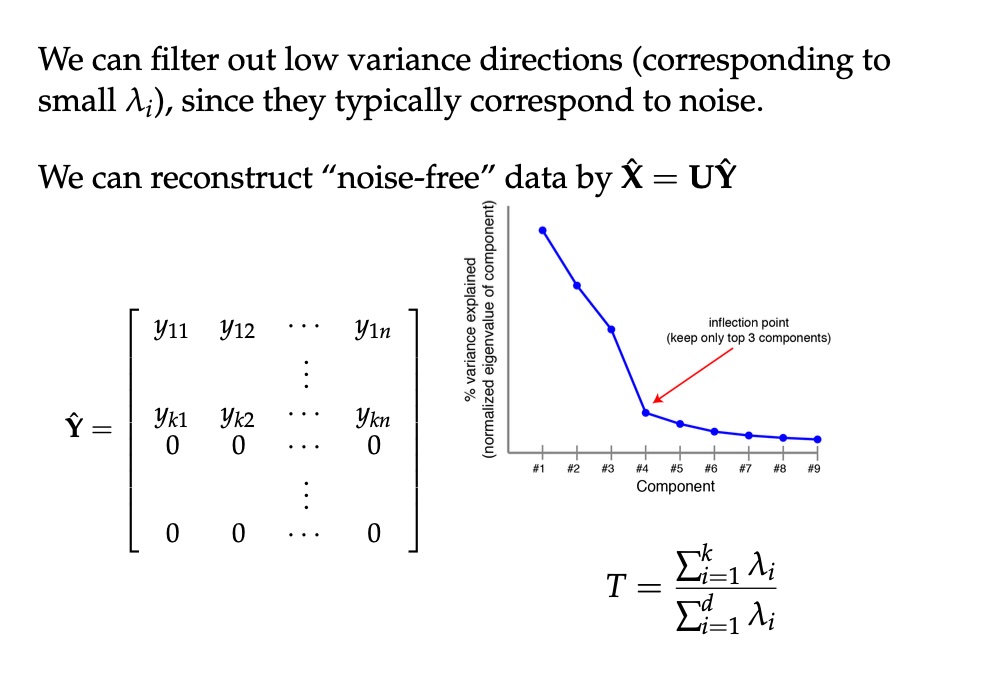
PCA of digits
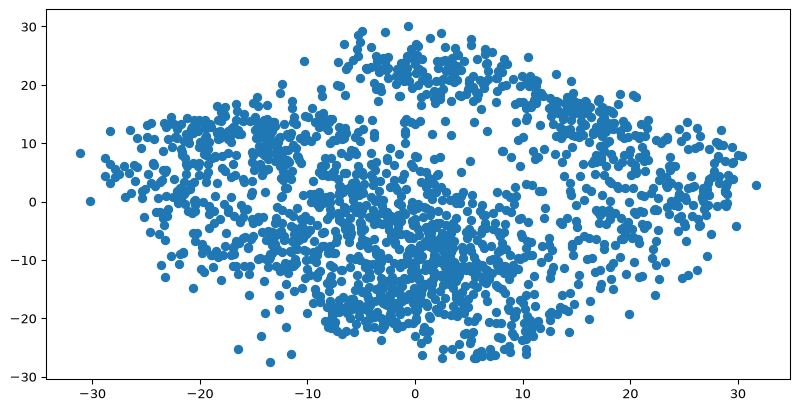
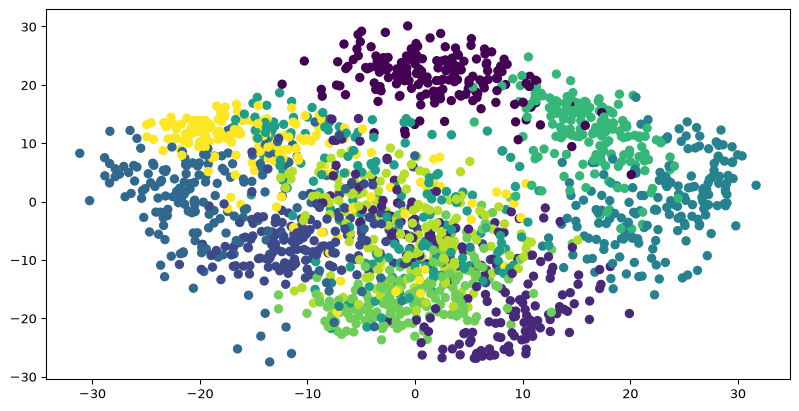
PCA of digits
Scaling Up

  • Covariance matrix can be really big!
    • \(\Sigma\) is \(n\) by \(n\)
    • 10000 features are not uncommon
    • computing eigenvectors is slow…
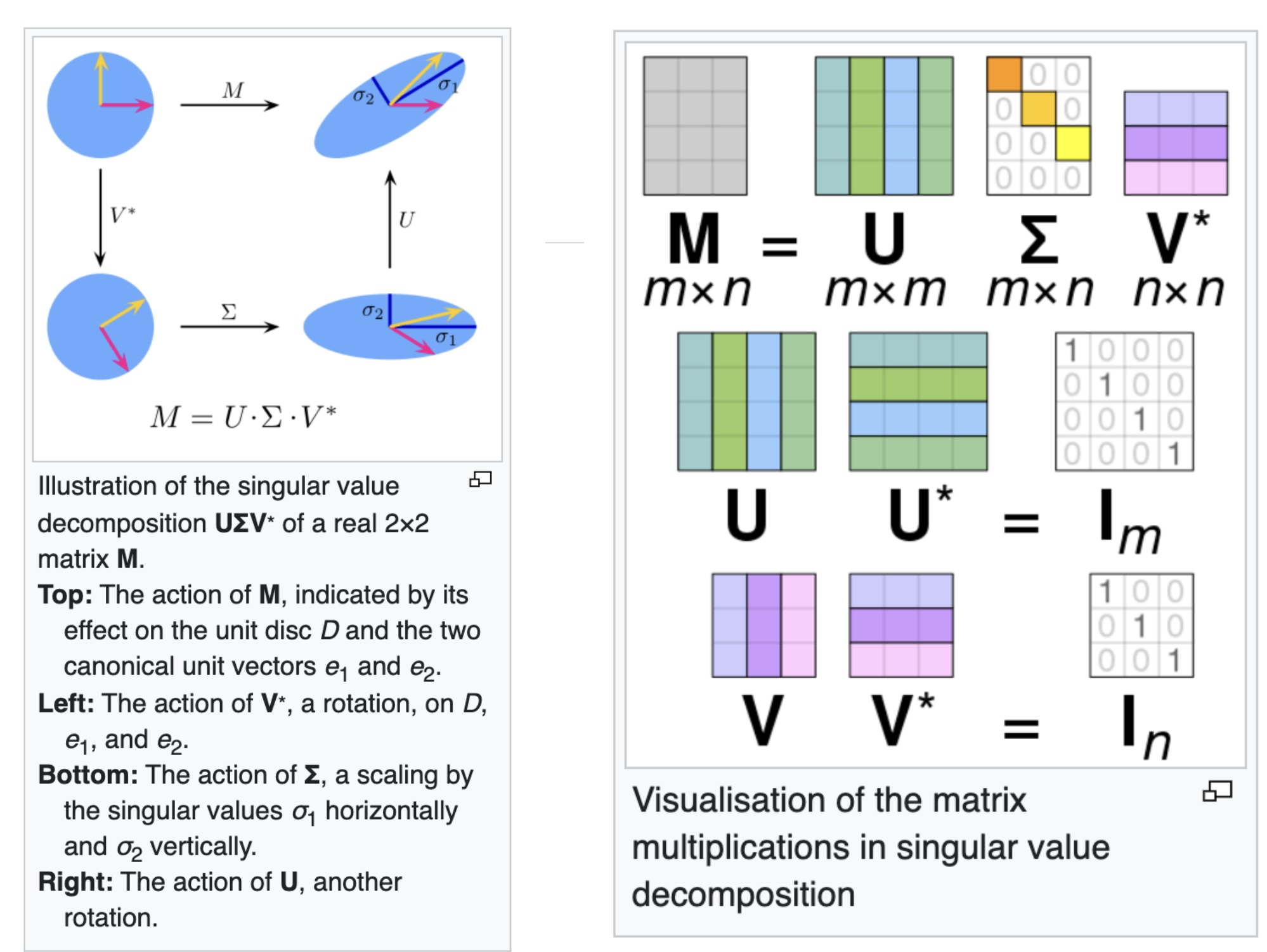
  • Solution: Singular Value Decomposition (SVD)
    • Finds the \(k\) largest eigenvectors
    • Widely implemented robustly in major packages

Singular Value Decomposition (SVD)

  • https://en.wikipedia.org/wiki/Singular_value_decomposition
Dimensionality Reduction Techniques

  • https://en.wikipedia.org/wiki/Dimensionality_reduction
    • Principal component analysis (PCA)
    • Non-negative matrix factorization (NMF)
    • Linear discriminant analysis (LDA)
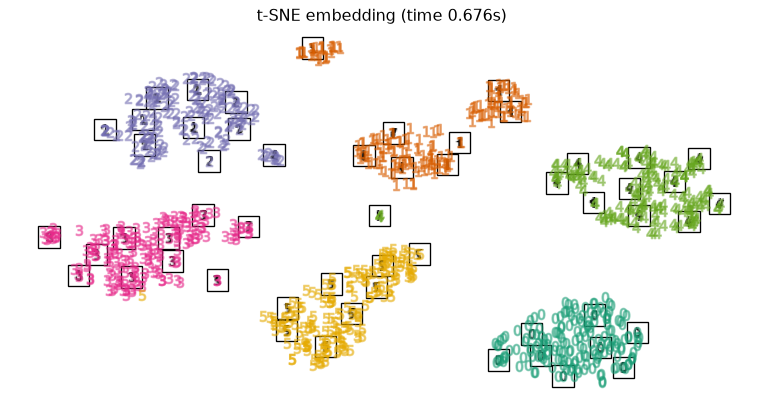
    • t-SNE
    • UMAP
    • many others

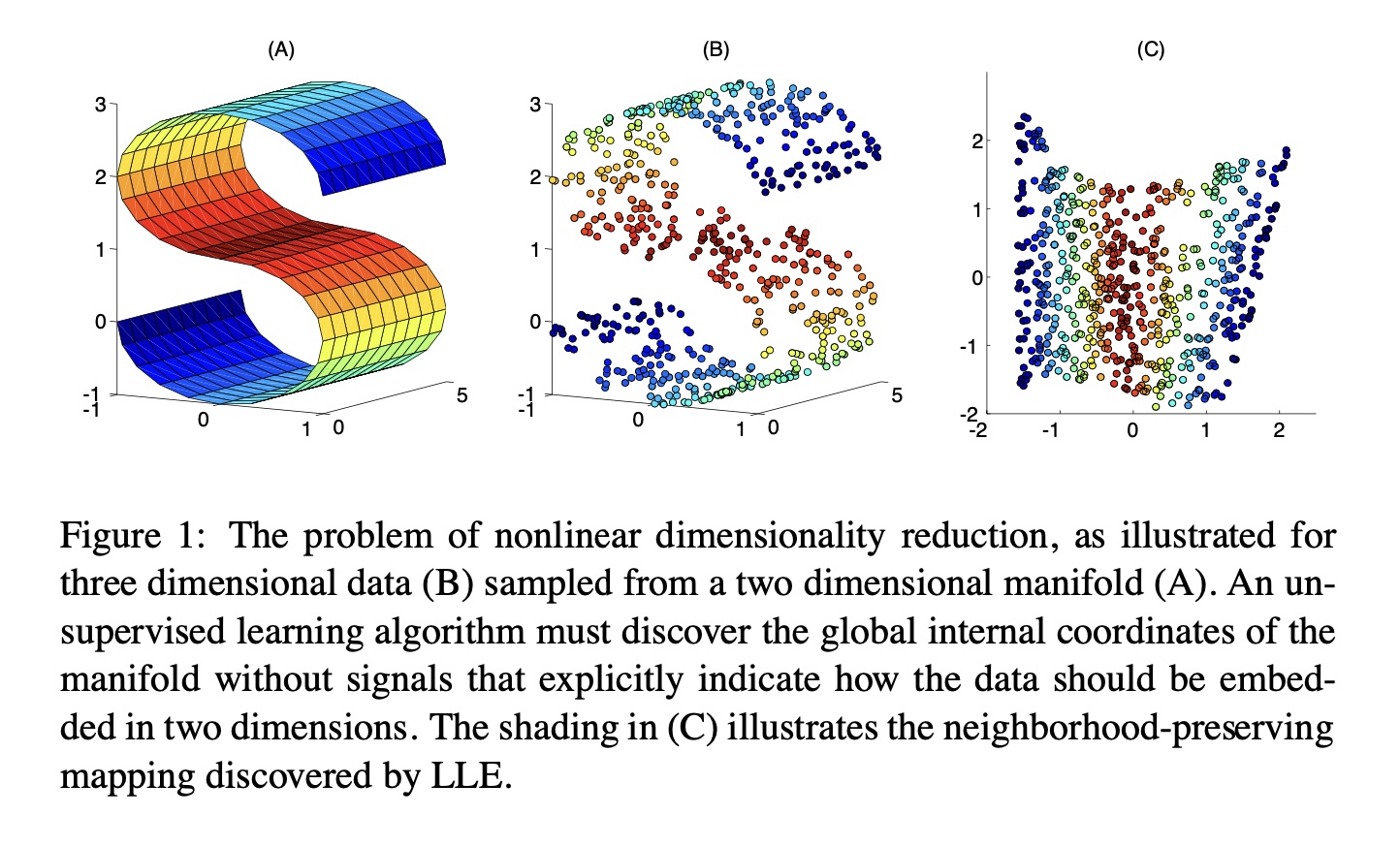
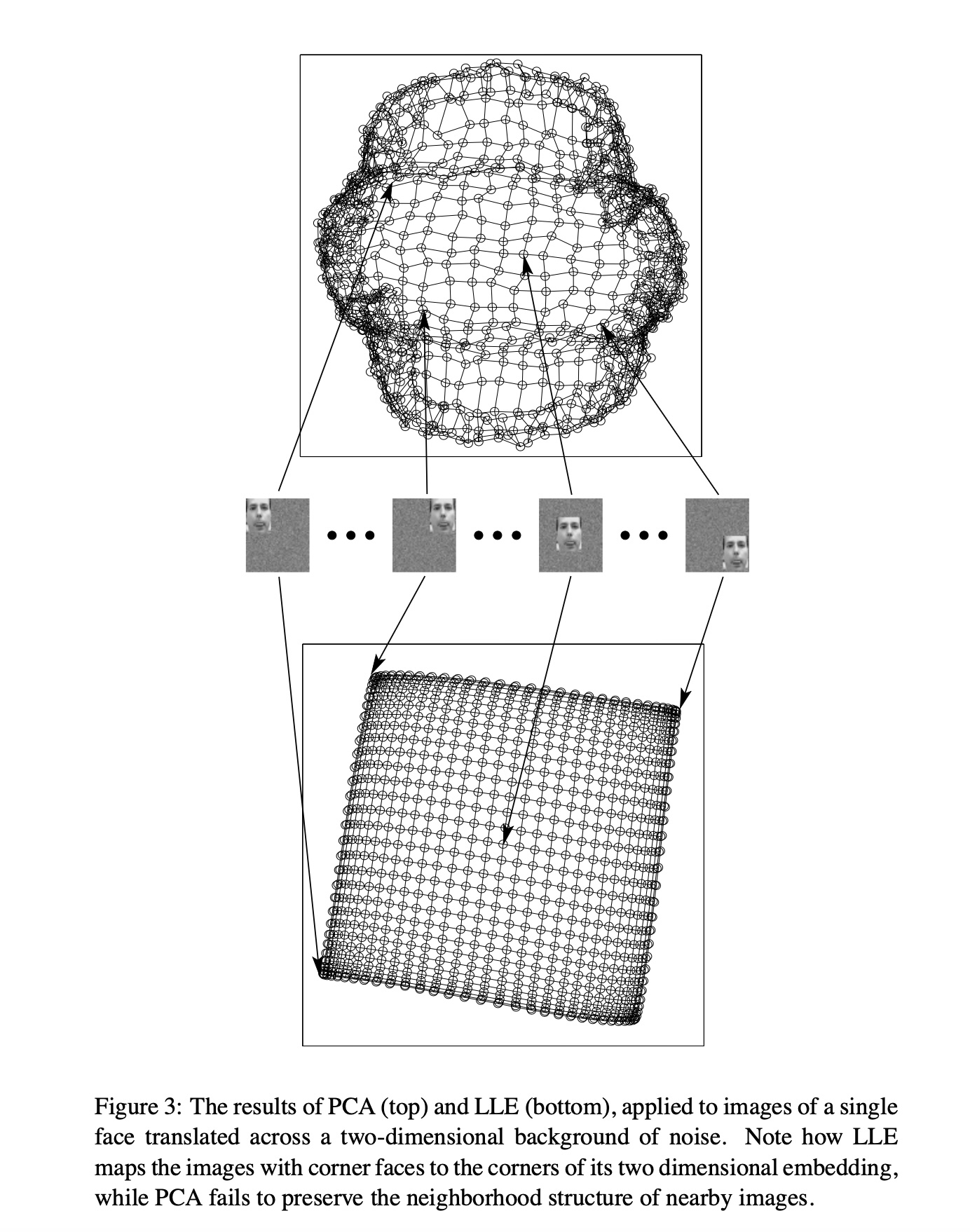
Locally Linear Embedding (LLE)

Preserving Local Manifold Neighborhoods
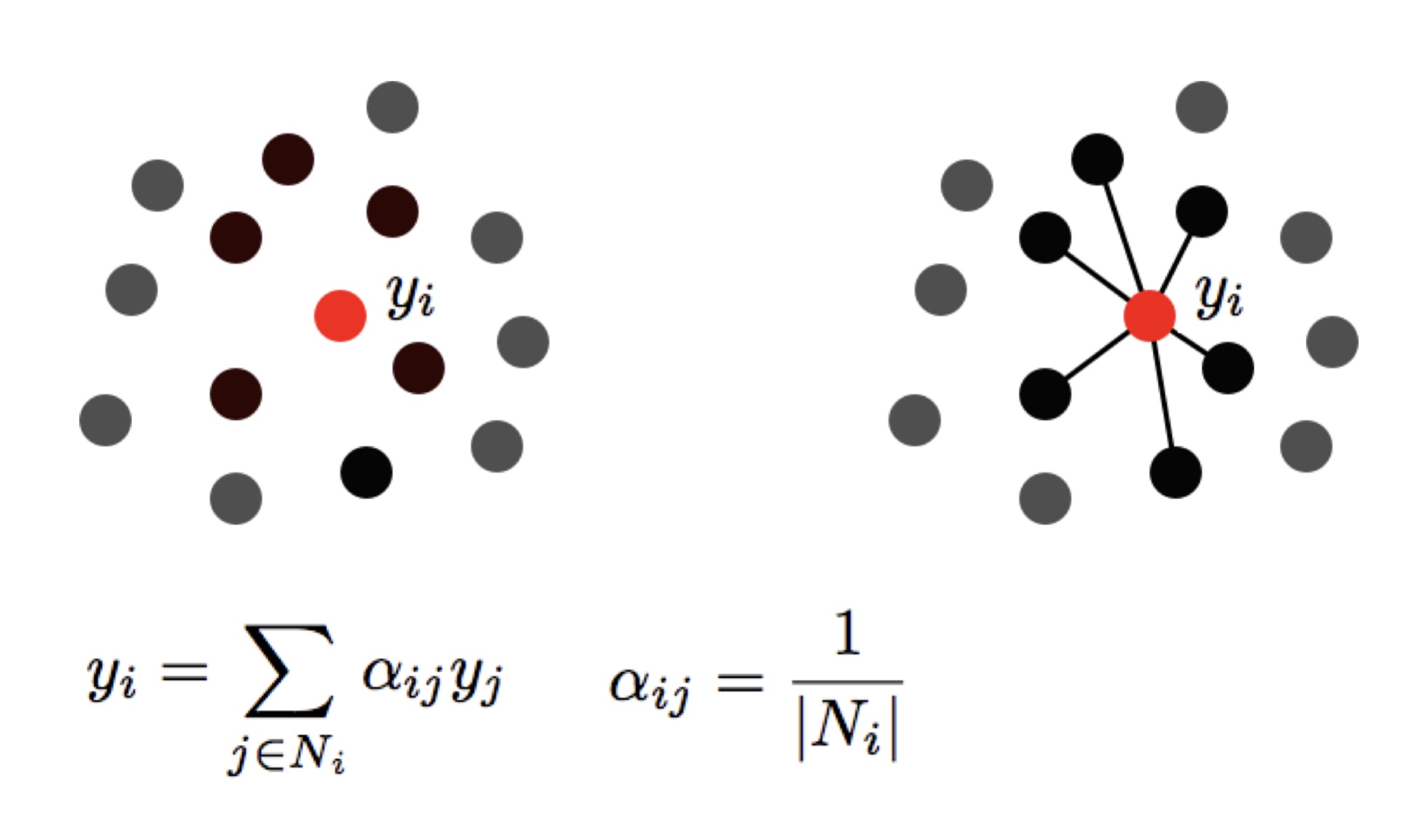
LLE
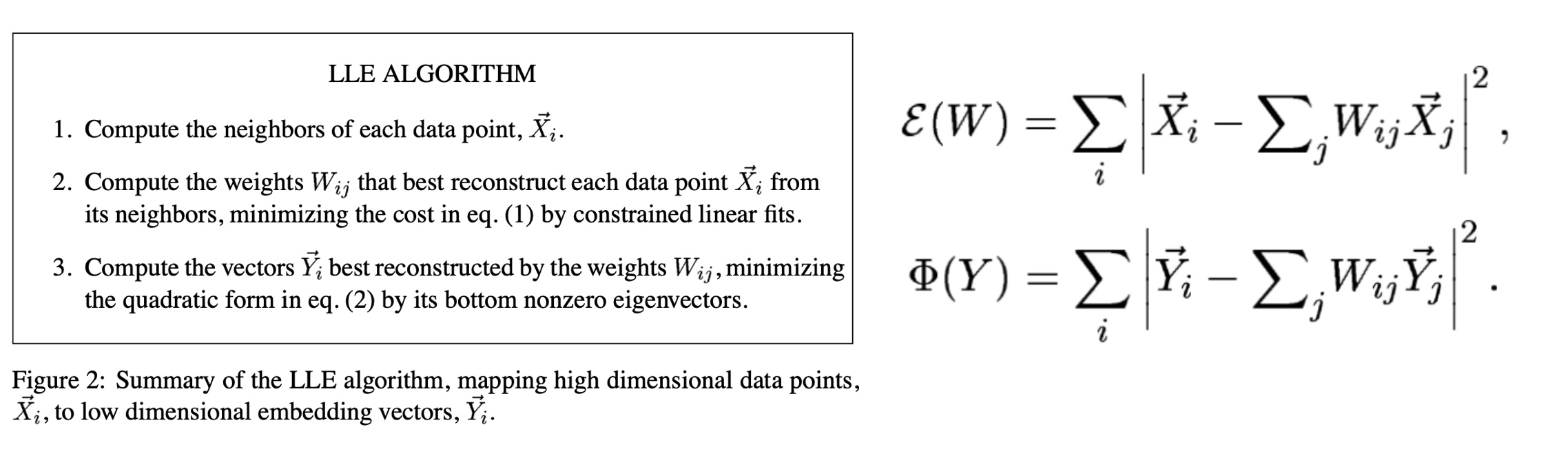
Read more

PCA vs LLE

Graph Layout using force based approach

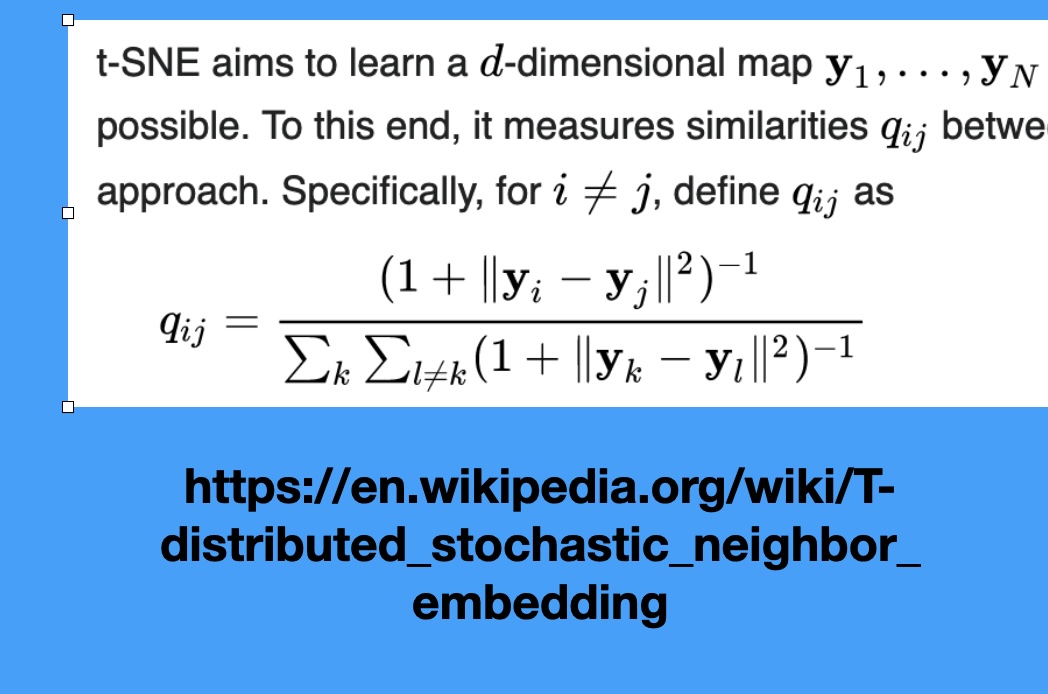
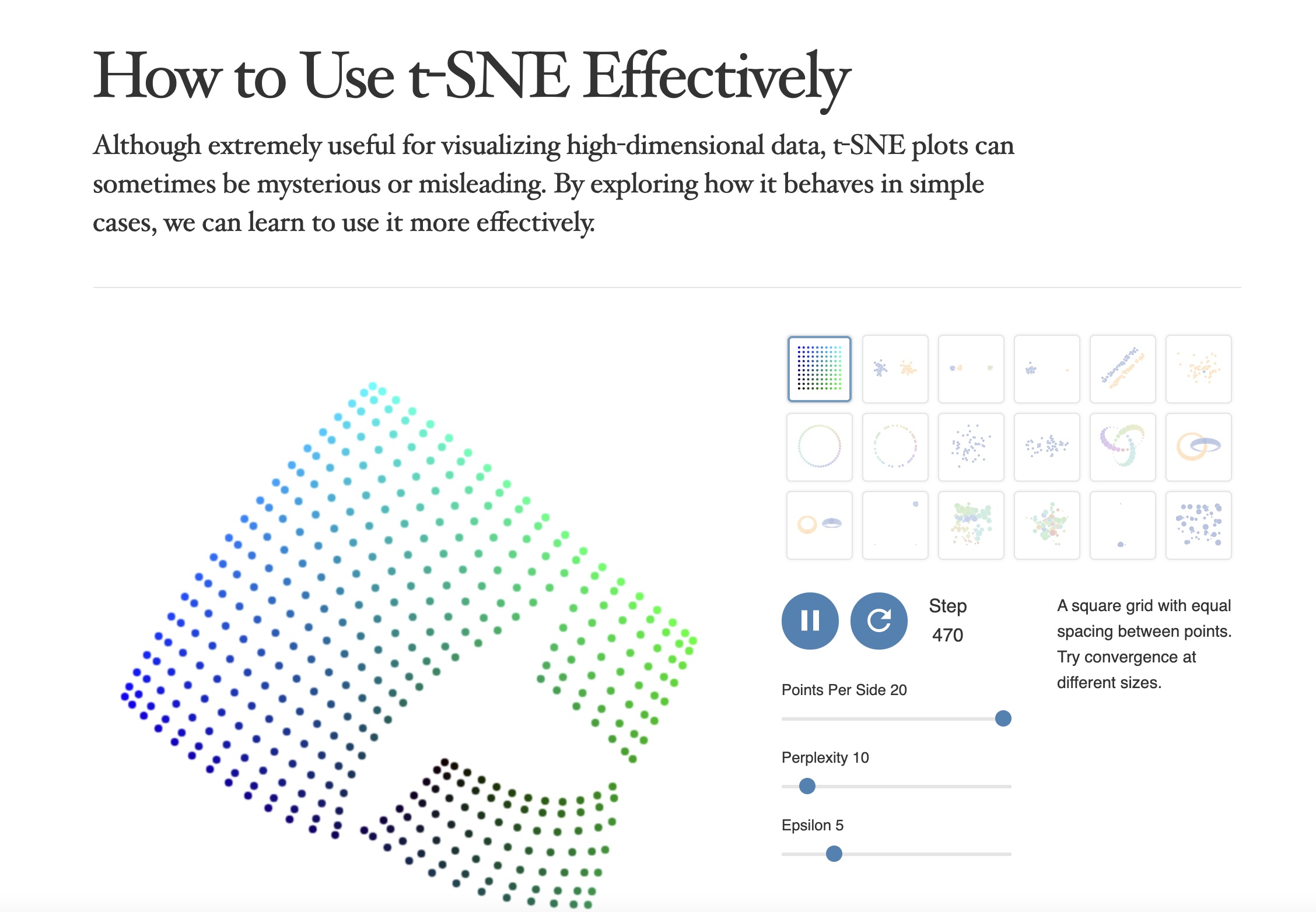
SNE and t-SNE

HERE is an excellent talk by t-SNE creator: video link
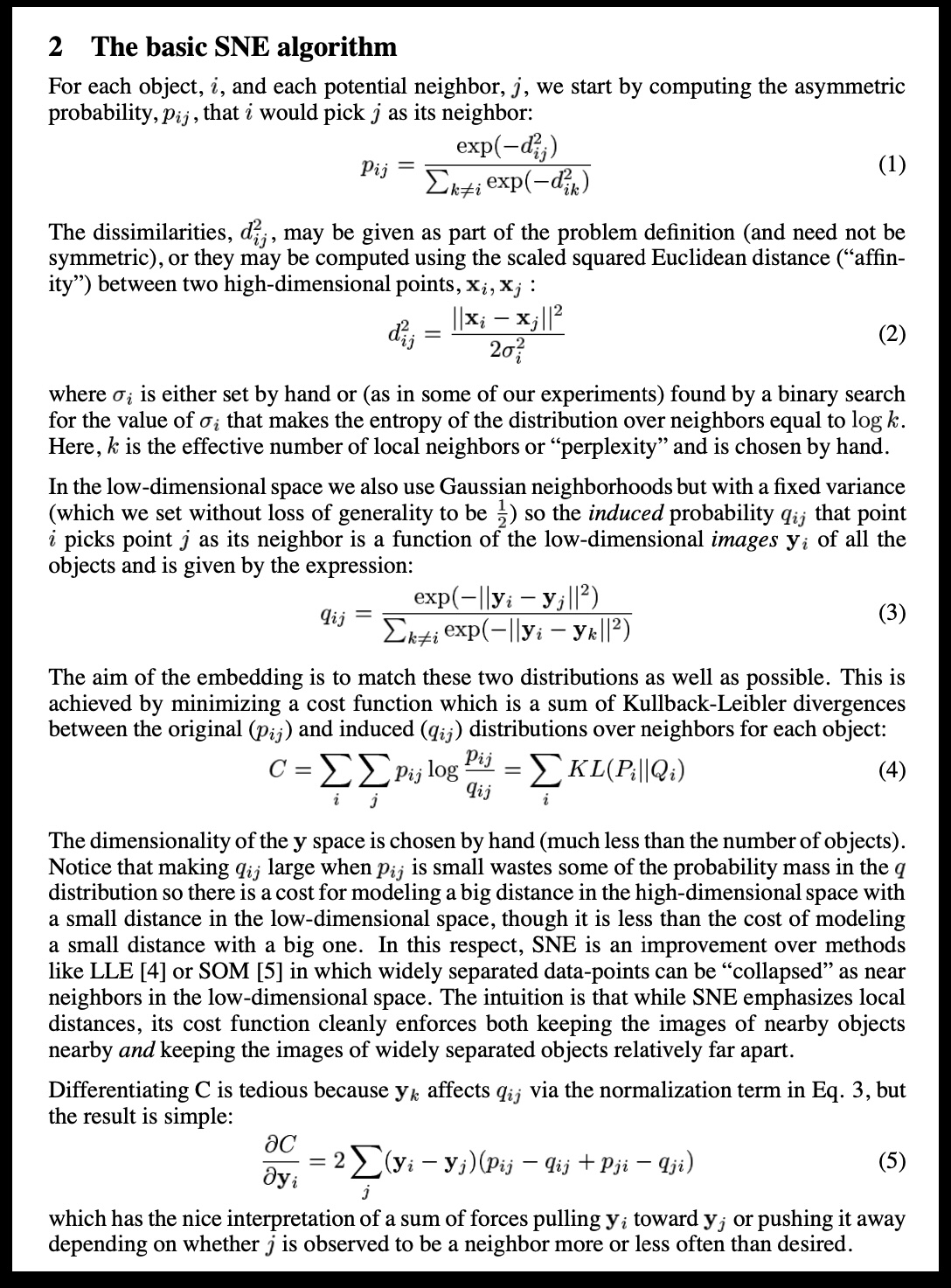
Read more

Read more

What about user interaction?