Topology
Autumn 2025
What is Topology?
What is Topology?
- Topology is the mathematical study of shape and space, focusing on properties preserved under continuous deformations (stretching, bending, but not tearing or gluing).
What is Topology?
- Topology is the mathematical study of shape and space, focusing on properties preserved under continuous deformations (stretching, bending, but not tearing or gluing).
- It generalizes geometry and analysis.
Examples
Examples
- open/close sets
Examples
- open/close sets
- Continuity
Examples
- open/close sets
- Continuity
- Compactness
Examples
- open/close sets
- Continuity
- Compactness
- Connectedness
Topological Spaces
Topological Spaces
A Topological space is a set \(\mathcal{X}\) with a collection \(\mathcal{T}\) of subsets satisfying:
- \(\emptyset \in \mathcal{T}, \mathcal{X} \in \mathcal{T}\)
- Closed under arbitrary unions
- Closed under finite intersections
Topological Spaces
A Topological space is a set \(\mathcal{X}\) with a collection \(\mathcal{T}\) of subsets satisfying:
- \(\emptyset \in \mathcal{T}, \mathcal{X} \in \mathcal{T}\)
- Closed under arbitrary unions
- Closed under finite intersections
Example: The real numbers \(\mathbb{R}\) with the standard topology.
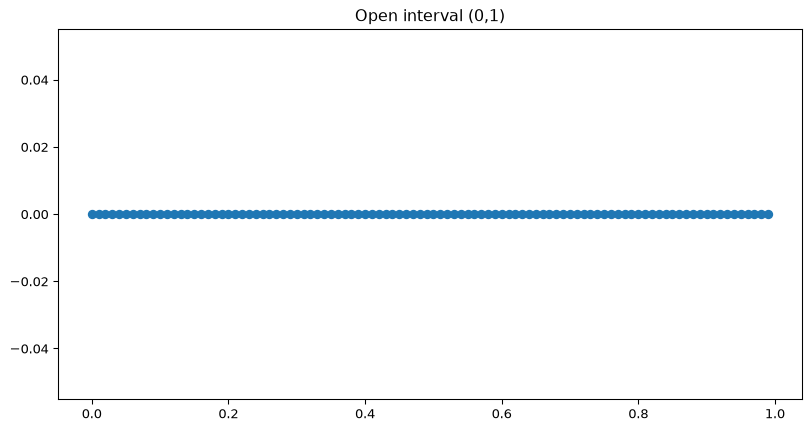
Open Sets in Python
Continuous Functions
A function \(f: \mathcal{X} \rightarrow \mathcal{Y}\) is continuous if the preimage of every open set in \(\mathcal{Y}\) is open in \(\mathcal{X}\).
Continuous Functions
A function \(f: \mathcal{X} \rightarrow \mathcal{Y}\) is continuous if the preimage of every open set in \(\mathcal{Y}\) is open in \(\mathcal{X}\).
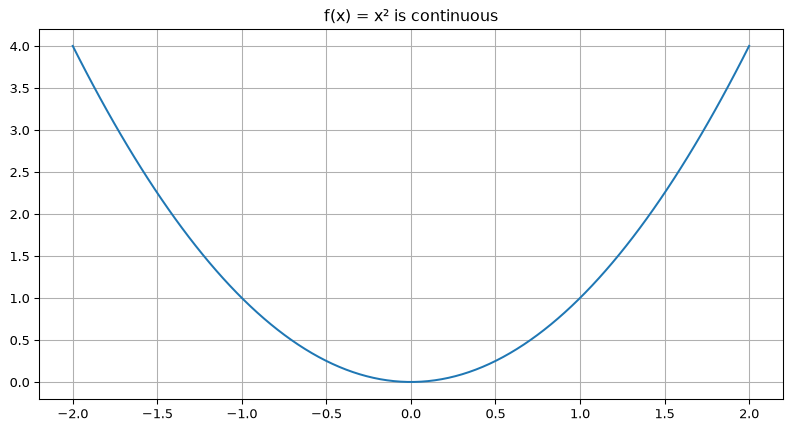
Example: \(f(x) = X^2\) is continuous in \(\mathbb{R}\).
Continuous Functions
Homeomorphism
Homeomorphism
A homeomorphism is a bijective (one-to-one and onto), continuous function between two topological spaces, with a continuous inverse.
Homeomorphism
A homeomorphism is a bijective (one-to-one and onto), continuous function between two topological spaces, with a continuous inverse.
- A bijective, continuous function with a continuous inverse.
- Homeomorphic spaces are “topologically the same”.
Homeomorphism
A homeomorphism is a bijective (one-to-one and onto), continuous function between two topological spaces, with a continuous inverse.
- A bijective, continuous function with a continuous inverse.
- Homeomorphic spaces are “topologically the same”.
Example:
- A coffee cup and a donut (torus) are homeomorphic—they both have one hole.
- A circle and a square are homeomorphic, but a circle and a line segment are not.
import matplotlib.pyplot as plt
import numpy as np

theta = np.linspace(0, 2 * np.pi, 100)
circle_x, circle_y = np.cos(theta), np.sin(theta)
square_x, square_y = np.sign(np.cos(theta)), np.sign(np.sin(theta))

plt.plot(circle_x, circle_y, label='Circle')
plt.plot(square_x, square_y, label='Square (homeomorphic)', linestyle='--')
plt.axis('equal')
plt.title('Homeomorphic Shapes: Circle and Square')
plt.show()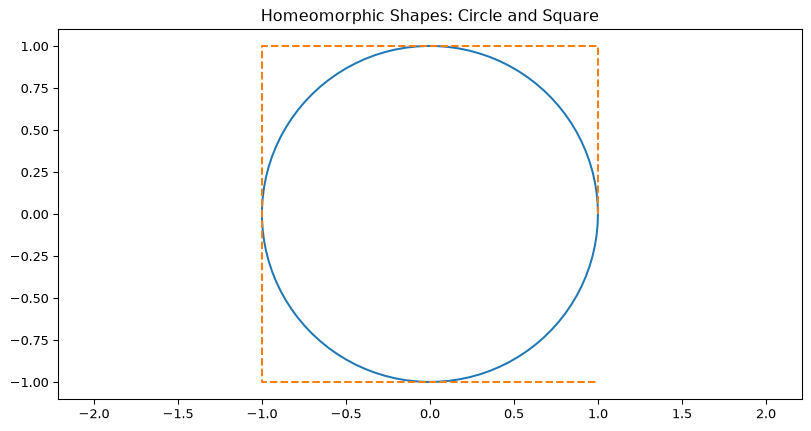
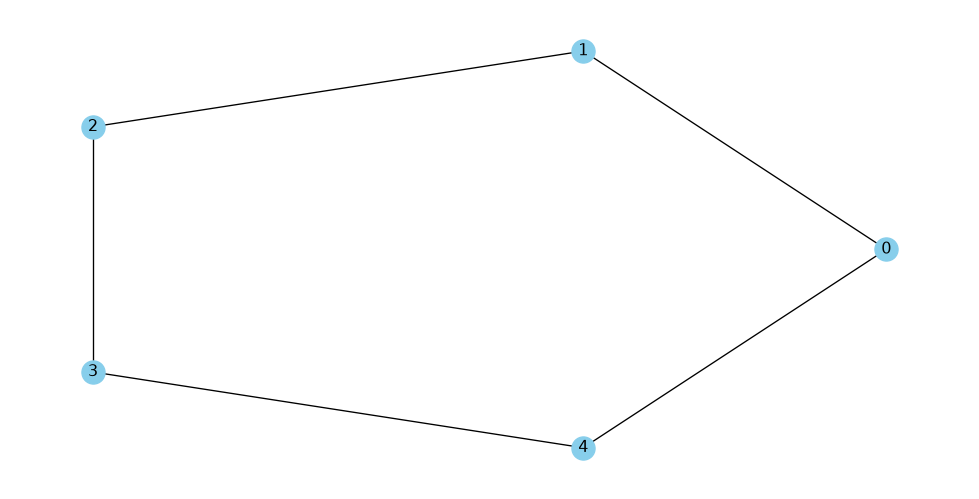
Example: Topology on Graphs
Topological Invariants
Topological Invariants
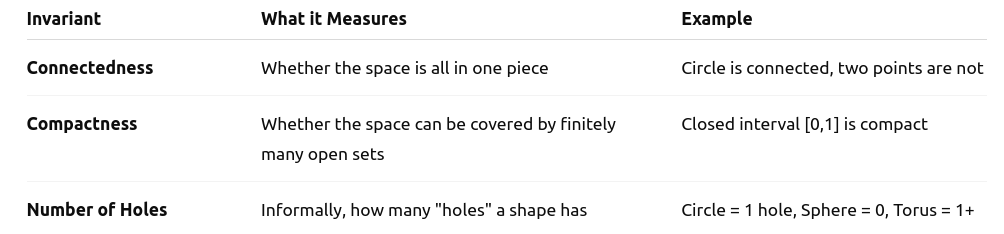
A topological invariant is a property of a topological space that remains unchanged under homeomorphisms.
It helps to classify and distinguish different spaces.
Topological Invariants
A topological invariant is a property of a topological space that remains unchanged under homeomorphisms.
It helps to classify and distinguish different spaces.
Euler Characteristic (classic invariant)
Euler Characteristic (classic invariant)
The Euler Characteristic (denoted \(\mathcal{X}\)) is a topological invariant — a number that describes a topological space’s shape or structure in a way that remains unchanged under continuous deformations (like stretching or bending, but not tearing or gluing).
Euler Characteristic (classic invariant)
The Euler Characteristic (denoted \(\mathcal{X}\)) is a topological invariant — a number that describes a topological space’s shape or structure in a way that remains unchanged under continuous deformations (like stretching or bending, but not tearing or gluing).
\(\mathcal{X} = V -E + F\)
Euler Characteristic (classic invariant)
The Euler Characteristic (denoted \(\mathcal{X}\)) is a topological invariant — a number that describes a topological space’s shape or structure in a way that remains unchanged under continuous deformations (like stretching or bending, but not tearing or gluing).
\(\mathcal{X} = V -E + F\)
Where:
- \(V\): Number of vertices (corners or points)
- \(E\): Number of edges (line segments connecting vertices)
- \(F\): Number of faces (flat surfaces bounded by edges)
This formula applies to many polyhedral surfaces (like cubes, pyramids, etc.) and also generalizes to other topological spaces.
Euler Characteristic (classic invariant)
Why is it important?
Euler Characteristic (classic invariant)
Why is it important?
- Topological invariant: It doesn’t change under stretching, bending, or twisting (homeomorphisms).
Euler Characteristic (classic invariant)
Why is it important?
- Topological invariant: It doesn’t change under stretching, bending, or twisting (homeomorphisms).
- Helps classify surfaces:
- Sphere: \(\mathcal{X} = 2\)
- Torus (donut): \(\mathcal{X} = 0\)
- double torus: \(\mathcal{X} = -2\)
- Sphere: \(\mathcal{X} = 2\)
Euler Characteristic (classic invariant)
Why is it important?
- Topological invariant: It doesn’t change under stretching, bending, or twisting (homeomorphisms).
- Helps classify surfaces:
- Sphere: \(\mathcal{X} = 2\)
- Torus (donut): \(\mathcal{X} = 0\)
- double torus: \(\mathcal{X} = -2\)
- Sphere: \(\mathcal{X} = 2\)
- Tells you about the number of holes: \(\mathcal{X} = 2 - 2g\) (for a closed, orientable surface of genus g)
where g is the number of “holes”.
Relation to homology
The Euler characteristic is also the alternating sum of Betti numbers (from homology):
\(\mathcal{X} = \beta_0 - \beta_1 + \beta_2 - \dots\)
Where:
- \(\beta_0\): Number of connected components
- \(\beta_1\): Number of loops/holes
- \(\beta_2\): Number of voids (like hollow spaces in 3D)
- And so on…
General Topological Definition
More generally, in algebraic topology, the Euler characteristic is the alternating sum of Betti numbers:
\(\mathcal{X} = \sum_{k=0}^n (-1)^k \beta_k\)
Where:
- \(\beta_0\): Number of connected components
- \(\beta_1\): Number of loops/holes
- \(\beta_2\): Number of voids (like hollow spaces in 3D)
- And so on…
What is a Simplex?
What is a Simplex?
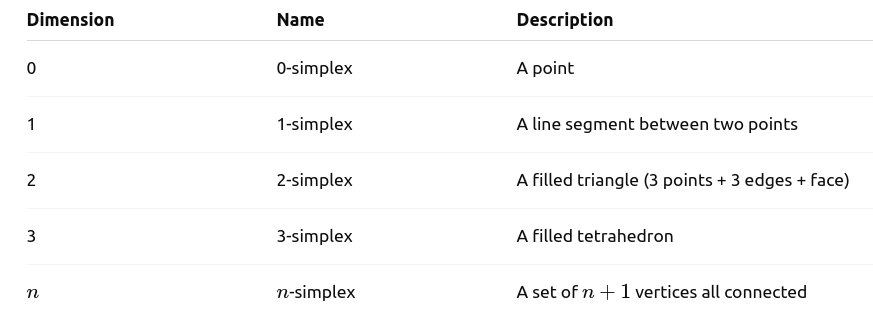
A simplex is a generalization of a triangle or tetrahedron to any dimension.
What is a Simplex?
A simplex is a generalization of a triangle or tetrahedron to any dimension.
What is a Simplex?
A simplex is a generalization of a triangle or tetrahedron to any dimension.
Each simplex contains all of its faces, meaning a 2-simplex contains the 3 edges and 3 vertices that define it.
What is a Simplicial Complex?
What is a Simplicial Complex?
A simplicial complex is a collection of simplices (points, edges, triangles, etc.) glued together nicely:
What is a Simplicial Complex?
A simplicial complex is a collection of simplices (points, edges, triangles, etc.) glued together nicely:
- Every face of a simplex must also be in the complex.
- The intersection of two simplices is either empty or a shared face.
What is a Simplicial Complex?
A simplicial complex is a collection of simplices (points, edges, triangles, etc.) glued together nicely:
- Every face of a simplex must also be in the complex.
- The intersection of two simplices is either empty or a shared face.
It’s like building a shape out of Lego blocks where each block is a simplex.
What is the Vietoris–Rips Complex?
What is the Vietoris–Rips Complex?
The Vietoris–Rips complex (or Rips complex) is a way to approximate the shape of a point cloud (a dataset in Euclidean space) by building a simplicial complex.
What is the Vietoris–Rips Complex?
The Vietoris–Rips complex (or Rips complex) is a way to approximate the shape of a point cloud (a dataset in Euclidean space) by building a simplicial complex.
How it works?
What is the Vietoris–Rips Complex?
The Vietoris–Rips complex (or Rips complex) is a way to approximate the shape of a point cloud (a dataset in Euclidean space) by building a simplicial complex.
How it works?
Given a set of points \(\mathcal{X}\) and a distance threshold \(\epsilon\):
- Convert each data point to a 0-simplex
- Connect two points if their distance is lower than \(\epsilon\) (1-simplex)
- Fill a triangle if all three edges between three points exist (2-simplex)
- Add them when all pairwise edges are present
What is the Vietoris–Rips Complex?
Purpose:
This complex gives a discrete, combinatorial representation of the shape of the data at a given scale \(\epsilon\). We compute homology of this complex to detect:
- Connected components (dimension 0)
- Loops (dimension 1)
- Voids (dimension 2), etc.
Persistent Homology
Persistent Homology
Persistent homology tracks topological features (e.g., connected components, holes, voids) across multiple scales of a dataset.
Persistent Homology
Persistent homology tracks topological features (e.g., connected components, holes, voids) across multiple scales of a dataset.
- Given a point cloud, we connect nearby points and track how connected components and holes evolve as we increase the scale.
Persistent Homology
Persistent homology tracks topological features (e.g., connected components, holes, voids) across multiple scales of a dataset.
- Given a point cloud, we connect nearby points and track how connected components and holes evolve as we increase the scale.
- Features that persist over many scales are considered meaningful, while short-lived ones are likely noise.
Persistent Homology - how to calculate?
- Build simplicial complexes (like Vietoris-Rips complex)
- Compute homology groups (Betti numbers)
- Visualize with persistence diagrams or barcodes
from sklearn.datasets import make_circles
from gtda.homology import VietorisRipsPersistence
from gtda.plotting import plot_diagram

X, _ = make_circles(n_samples=100, noise=0.05) # Generate circle-shaped point cloud
vr = VietorisRipsPersistence(homology_dimensions=[0, 1]) # Persistent homology
diagrams = vr.fit_transform([X])

# Visualize
plot_diagram(diagrams[0])
Applications of Topology
- Data Analysis (TDA)
- Robotics (Configuration Spaces)
- Physics (Quantum Fields)
- Computer Vision
- Network Science
